
Balinese Beliefs in Spirit Communication, Mediumship, and Spiritual Dimensions
Introduction
Bali, known worldwide for its rich culture and Hindu-influenced traditions, maintains a deeply spiritual worldview where the seen and unseen worlds are inseparably linked. In Balinese belief, the universe is filled with spirits, ancestors, and deities who interact with humans daily. Spirit communication and forms of mediumship are central to rituals, healing, and maintaining cosmic harmony.
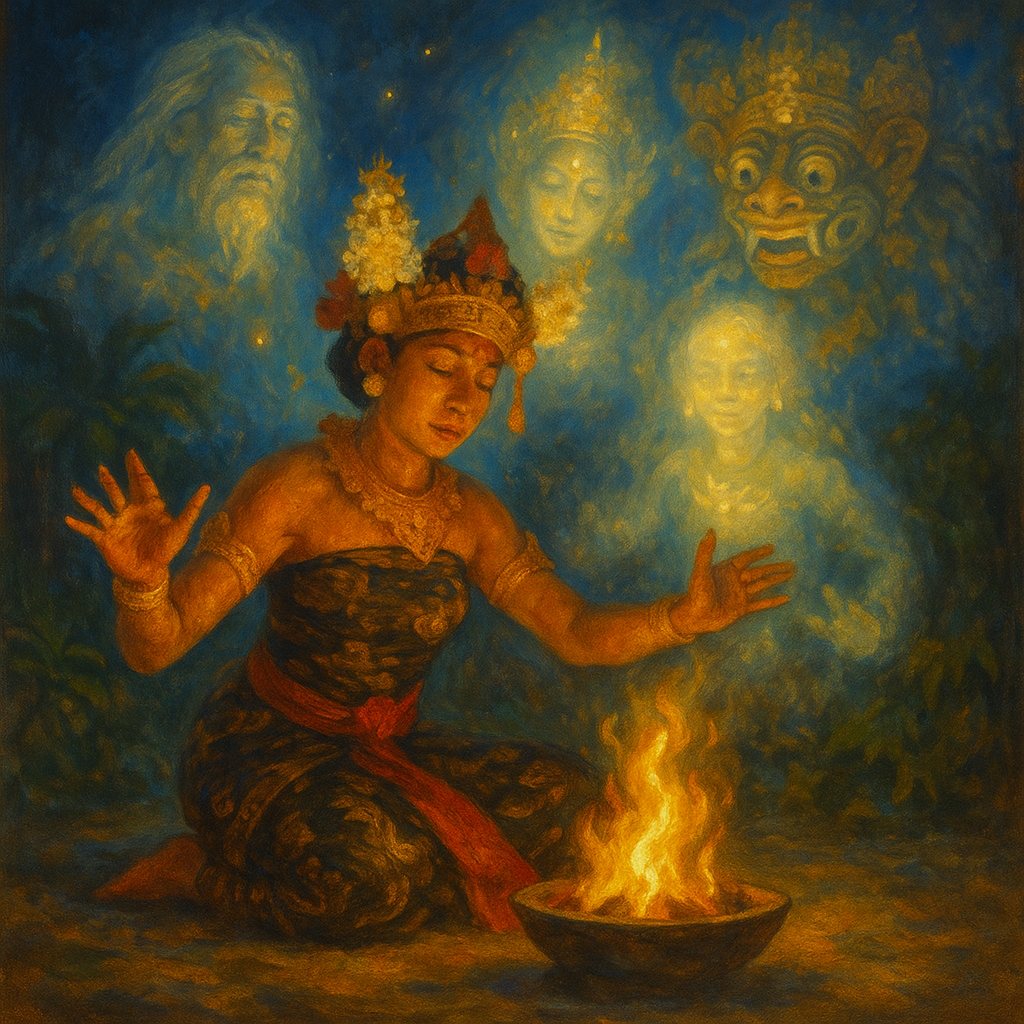
The Balinese Cosmology: Three Realms of Existence
Balinese Hinduism (Agama Hindu Dharma) describes a layered universe, expressed in the principle of Tri Loka (Three Worlds):
Bhur Loka (the Lower World): Realm of demons, restless spirits, and negative forces.
Bwah Loka (the Middle World): The human realm, where people must live in balance with higher and lower powers.
Swah Loka (the Upper World): Domain of gods, deities, and ancestral spirits who guide and protect.
Life is seen as a negotiation between these realms, with rituals ensuring balance between light and dark, order and chaos. Spirit communication and mediumship serve as bridges across these dimensions.
Spirit Communication in Balinese Traditions
1. Ancestral Spirits
Ancestors (leluhur) are believed to continue existing after death, influencing family wellbeing.
Offerings (banten) are made daily at household shrines to maintain dialogue with ancestors.
During Ngaben (cremation ceremonies), priests and mediums assist the soul’s transition to the higher realms.
2. Mediumship and Possession Rituals
Balinese culture embraces trance and spirit possession as sacred acts.
In ceremonies such as the Sanghyang Dedari dance, spirits temporarily inhabit mediums (often young girls), who move in ways said to be guided by divine beings.
Mediums (balian healers, or temple trance specialists) may allow deities, protective spirits, or ancestors to speak through them, offering blessings, warnings, or healing.
3. Priests and Balian (Healers)
Pedanda (High Priests): Conduct rituals to communicate with deities through mantra and fire offerings.
Balian (Traditional Healers): Often act as intermediaries with the spirit world, diagnosing illnesses attributed to spirit interference and negotiating with those entities for healing.
Spiritual Dimensions and Entities
Balinese cosmology includes a wide range of beings who communicate with humans:
Dewa and Dewi (Gods/Goddesses): Celestial beings worshipped in temples, invoked in ritual.
Bhuta Kala (Demons/Elemental Spirits): Powerful energies requiring offerings to prevent disruption.
Ancestors (Leluhur): Active protectors of family lines.
Rangda and Barong: Symbolic figures representing chaos and harmony, who engage in ritual battles enacted through dance and trance, mediated by human performers.
Communication with these beings occurs through ritual offerings, trance, and temple ceremonies, reflecting a dynamic balance of spiritual dimensions.
Techniques of Spirit Contact
Balinese traditions have developed refined methods of spirit communication, including:
Trance Dances (Sanghyang, Barong, Rangda): Ritual dances in which performers enter altered states and embody spiritual forces.
Offerings (Banten): Daily offerings of flowers, rice, and incense act as direct communication with unseen beings.
Mantra and Prayer: Priests use sacred Sanskrit and Balinese mantras to invoke deities.
Mediumship in Healing: Balian healers diagnose illness by consulting spirits, often entering light trance.
Temple Festivals (Odalan): Large-scale ceremonies where deities are invited to descend into effigies, priests, or mediums.
Comparisons with Western Mediumship
Similarities: Trance, possession, ancestral communication, healing, and spirit messages.
Differences: In Bali, mediumship is collective and ritualized, woven into festivals, temple ceremonies, and communal healing, rather than individual séances. Communication is not about proving survival, but about maintaining cosmic harmony.
Continuity and Modern Practice
Despite tourism and modernization, spirit communication and mediumship remain living traditions in Bali:
Daily offerings connect households with spirits.
Temple trance rituals continue to draw local and international audiences.
Balian healers are still widely consulted for illnesses of both physical and spiritual origin.
Cultural performances like Barong and Rangda dances preserve ancient practices of spirit embodiment.
These traditions demonstrate that Balinese spirituality is not static but evolving, while preserving its central belief in communication across dimensions.
Conclusion
Balinese beliefs in spirit communication, mediumship, and spiritual dimensions reflect a worldview where gods, ancestors, and spirits are ever-present. Through trance dances, offerings, priestly rituals, and healing practices, Balinese people maintain constant dialogue with the unseen world.
Unlike Western mediumship, which often emphasizes personal evidence of spirit survival, Balinese practices emphasize cosmic balance, communal participation, and integration with ritual life. This makes Bali a unique cultural landscape where the spiritual and material are seamlessly woven together.